A practical guide to building balanced meals using your hand, your plate, and simple visual cues
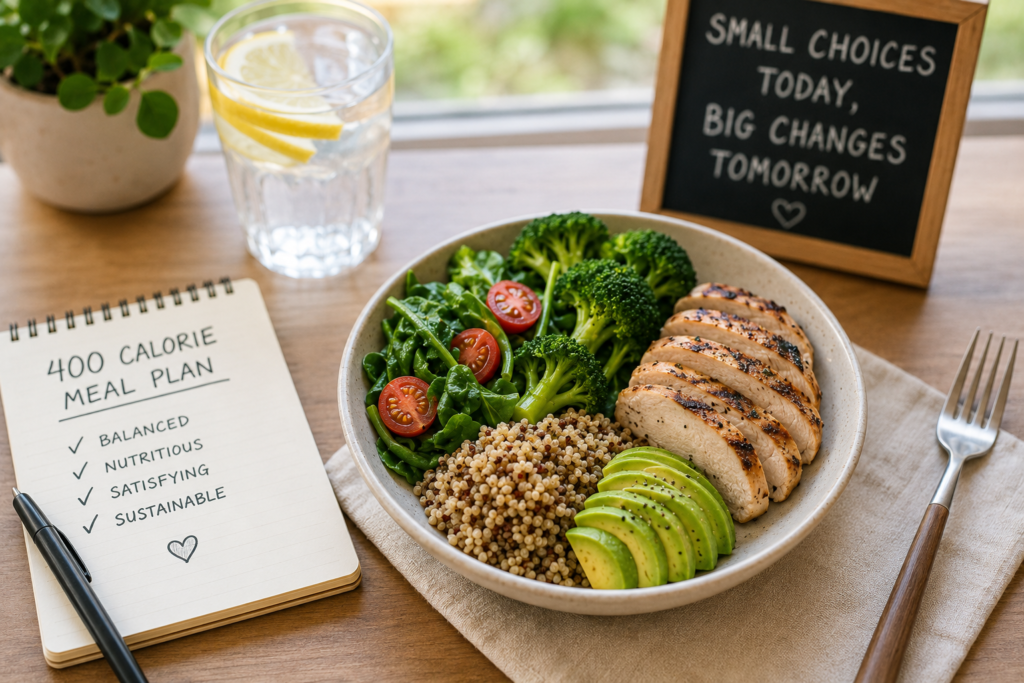
Counting every gram of food can be helpful for a while, but it can also become exhausting. Most people do not want to weigh chicken, rice, avocado, or olive oil forever — especially on busy weekdays, when lunch is packed in a container, eaten at work, or grabbed between errands.
The good news? You can build satisfying 400-calorie meals without using a food scale every single time.
A 400-calorie meal does not need to feel tiny, restrictive, or “diet-like.” When built well, it usually includes four simple parts:
protein + complex carbohydrates + vegetables + a small source of healthy fat
This structure helps make the meal more filling, more balanced, and easier to repeat in real life.
This guide will show you how to estimate portions using your hand, your plate, and a few everyday visual tricks — so you can stay close to your 400-calorie goal without obsessing over exact numbers.
Why 400 Calories Can Be a Useful Meal Target
A 400-calorie meal is not magic, but it can be a very practical framework.
For many people aiming for weight loss or weight maintenance, meals around 400 calories can help create structure without feeling overly restrictive. If someone eats three 400-calorie meals and adds one or two snacks, the day can often fit into a realistic calorie range.
But the quality of those 400 calories matters.
A 400-calorie meal made only from crackers or pastries will probably leave you hungry soon after. A balanced 400-calorie meal with protein, fiber-rich carbohydrates, vegetables, and a little fat will usually feel much more satisfying.
A good 400-calorie plate should aim to include:
A palm-sized portion of protein
This helps with fullness and supports muscle maintenance.
A small portion of complex carbohydrates
This gives energy and makes the meal feel complete.
Plenty of vegetables
These add volume, fiber, color, and nutrients for very few calories.
A small amount of healthy fat
This improves flavor and satiety, but the portion matters because fats are calorie-dense.
The goal is not perfection. The goal is to get close enough, often enough.
The Plate Method: The Easiest Way to Build a 400-Calorie Meal
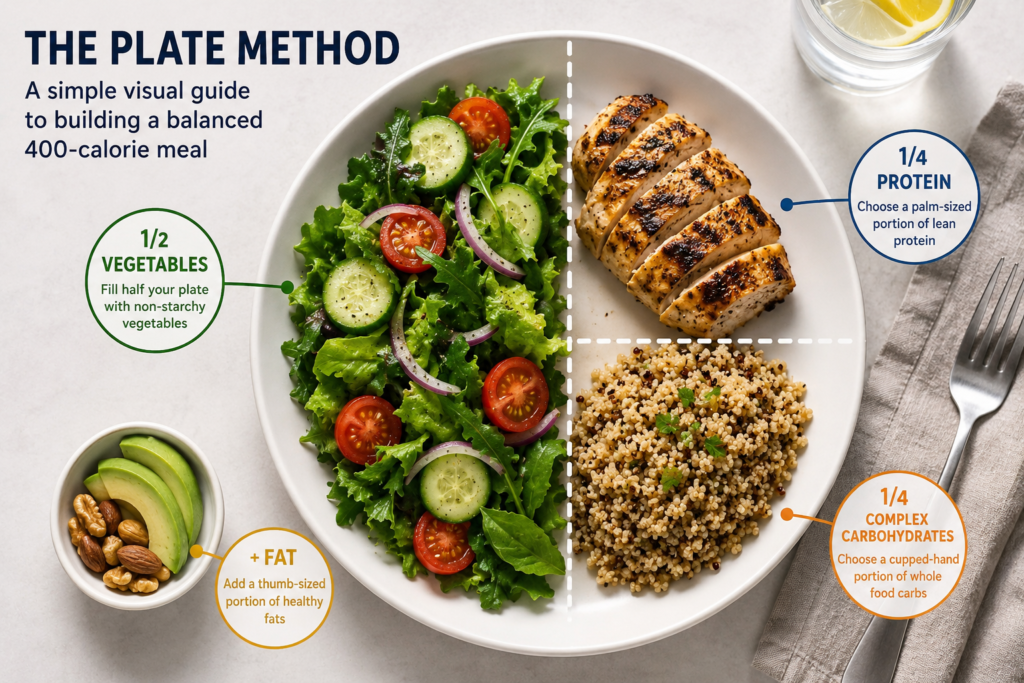
The plate method is one of the simplest ways to build a balanced meal without weighing anything.
Imagine your plate divided into sections:
Half of the plate: non-starchy vegetables
One quarter of the plate: lean protein
One quarter of the plate: complex carbohydrates
A small add-on: healthy fat
For a 400-calorie meal, this works best on a medium plate, around 9 inches / 23 cm wide. If your plate is very large, the same visual sections can accidentally become much bigger portions.
Half the Plate: Vegetables
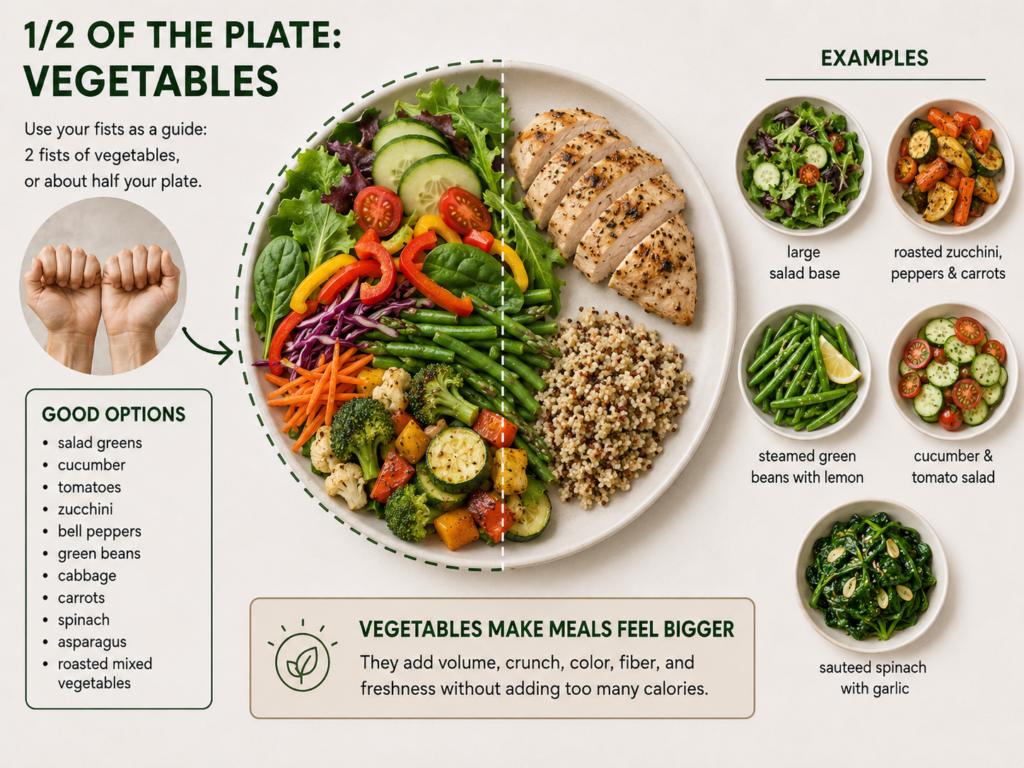
Vegetables are your best friend when building a filling 400-calorie meal.
They add volume, crunch, color, fiber, and freshness without using up too many calories. This means your plate looks generous, even when the total calorie count stays moderate.
Good options include:
- salad greens
- cucumber
- tomatoes
- zucchini
- bell peppers
- green beans
- cabbage
- carrots
- spinach
- asparagus
- roasted mixed vegetables
For most 400-calorie meals, aim for two fists of vegetables or about half your plate.
Examples:
- a large salad base
- a bowl of roasted zucchini, peppers, and carrots
- steamed green beans with lemon
- cucumber and tomato salad
- sautéed spinach with garlic
Vegetables are also useful because they let you keep portions of higher-calorie foods smaller without making the meal feel small.
One Quarter of the Plate: Protein
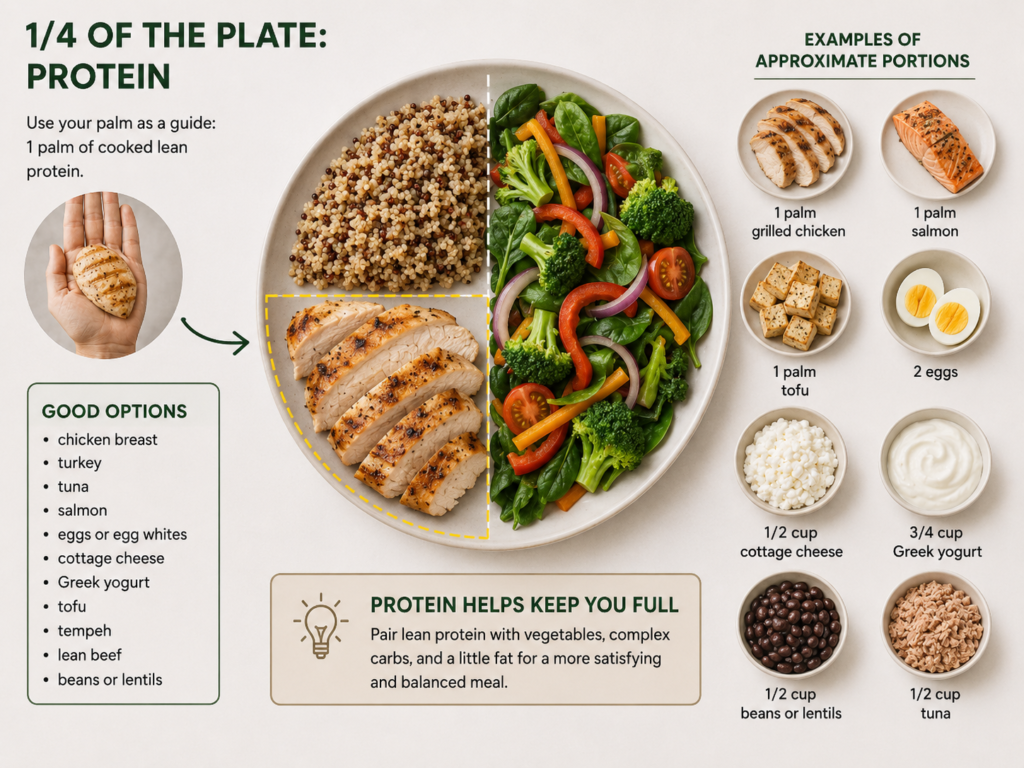
Protein is the anchor of a satisfying 400-calorie meal.
Without enough protein, a low-calorie meal can feel light, snack-like, or leave you hungry one hour later. The easiest way to estimate protein is with your palm.
A good portion is usually:
1 palm of cooked lean protein
This means the size and thickness of your palm, without the fingers.
Good protein options include:
- chicken breast
- turkey
- tuna
- salmon
- eggs or egg whites
- cottage cheese
- Greek yogurt
- tofu
- tempeh
- lean beef
- beans or lentils
For a 400-calorie plate, lean proteins are easier to work with because they give you more volume for fewer calories. Fattier proteins can still fit, but you may need to reduce added fats or carbohydrates.
For example:
- grilled chicken breast + rice + vegetables + yogurt dressing
- tuna + potatoes + salad + light vinaigrette
- tofu + noodles + stir-fry vegetables + soy-lime sauce
- eggs + whole-grain toast + vegetables + avocado
One Quarter of the Plate: Complex Carbohydrates
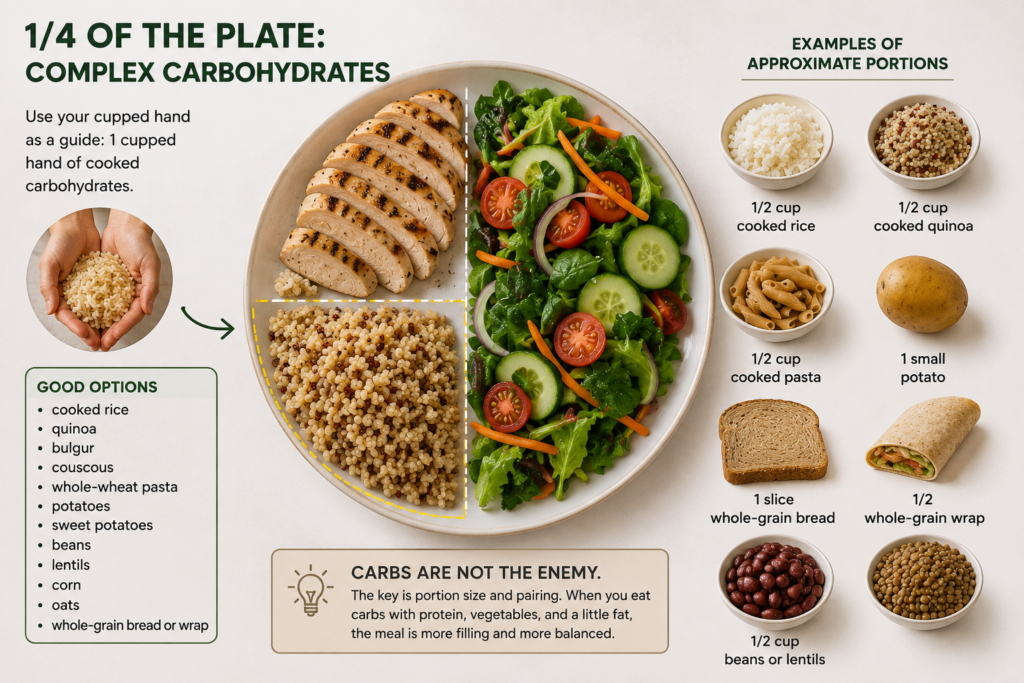
Carbohydrates are often the part people either overdo or avoid completely. Neither extreme is necessary.
For a balanced 400-calorie meal, choose a small, intentional portion of complex carbs.
Use this visual guide:
1 cupped hand of cooked carbohydrates
This is usually enough for a 400-calorie meal, especially when paired with protein and vegetables.
Good options include:
- cooked rice
- quinoa
- bulgur
- couscous
- whole-wheat pasta
- potatoes
- sweet potatoes
- beans
- lentils
- corn
- oats
- whole-grain bread or wrap
Examples of approximate portions:
- ½ cup cooked rice
- ½ cup cooked quinoa
- ½ cup cooked pasta
- 1 small potato
- 1 slice whole-grain bread
- ½ whole-grain wrap
- ½ cup beans or lentils
Carbohydrates are not the enemy. The key is portion size and pairing. When you eat carbs with protein, vegetables, and a little fat, the meal is usually more filling and more balanced.
The Smallest Section: Healthy Fats
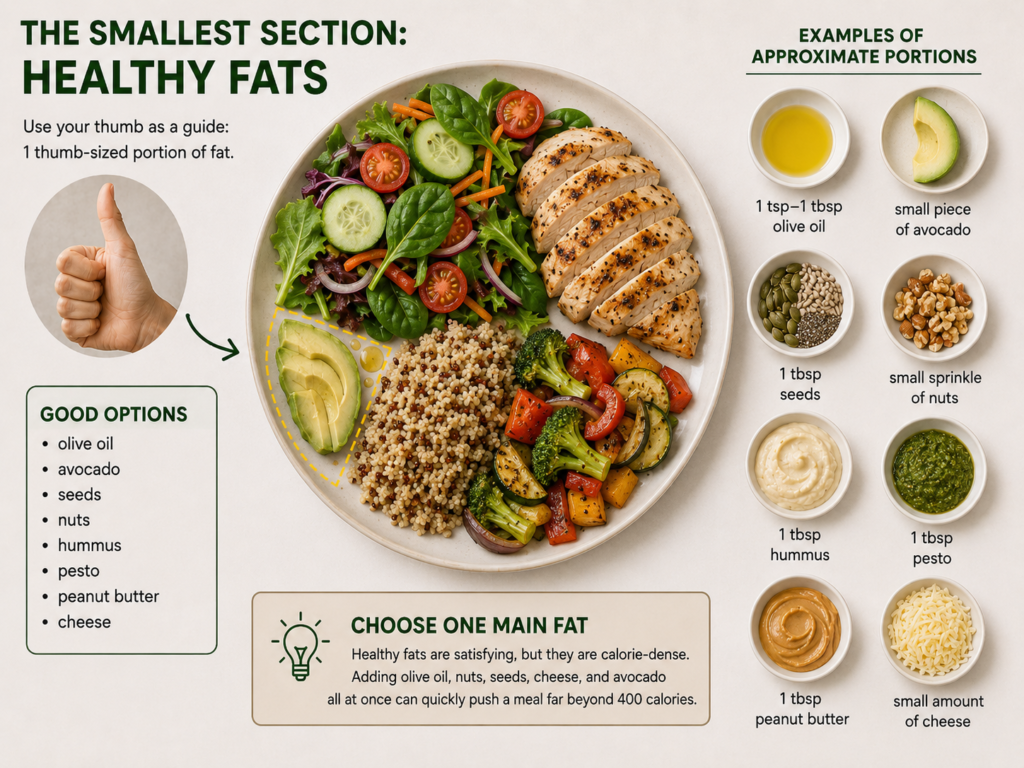
Healthy fats make food taste better. They also help with satisfaction. But they are very calorie-dense, so this is the part where small changes matter most.
Use your thumb as a guide.
For a 400-calorie meal, aim for:
1 thumb-sized portion of fat
This can mean:
- 1 teaspoon to 1 tablespoon olive oil
- a small piece of avocado
- 1 tablespoon seeds
- a small sprinkle of nuts
- 1 tablespoon hummus
- 1 tablespoon pesto
- 1 tablespoon peanut butter
- a small amount of cheese
This is where many “healthy” meals quietly become much higher in calories.
For example, olive oil, nuts, seeds, cheese, and avocado are nutritious — but adding all of them to the same bowl can quickly turn a 400-calorie meal into a 700-calorie meal.
A good rule:
Choose one main fat per meal.
Not olive oil + avocado + nuts + cheese all together.
The Hand Method: Your No-Scale Portion Guide
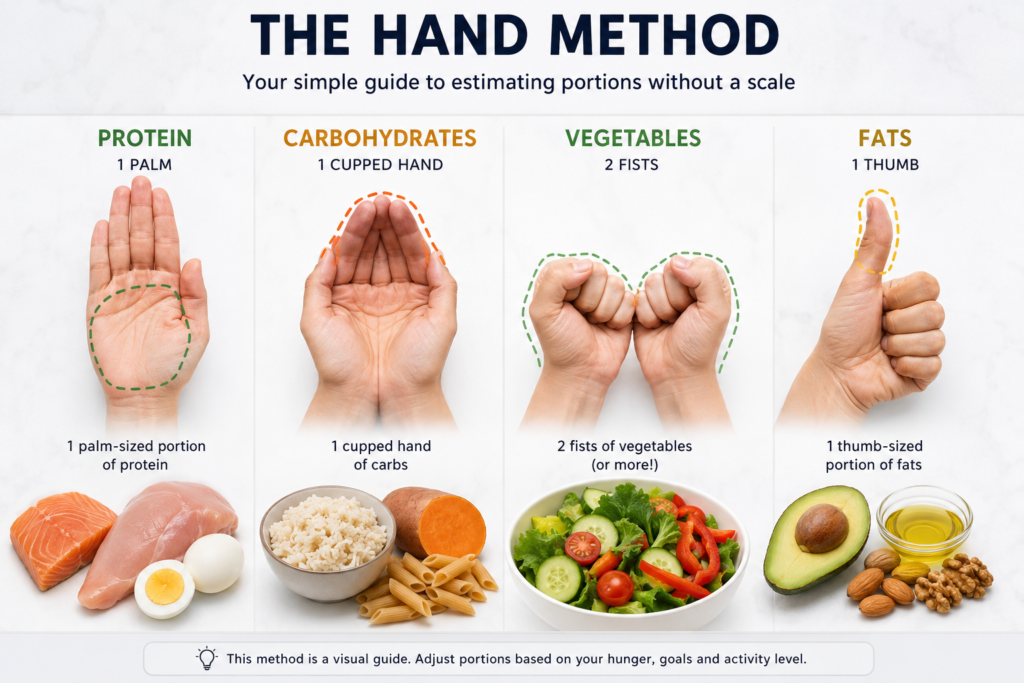
Your hand is one of the easiest tools for estimating portions because it is always with you.
Here is the simplest version:
Protein = 1 palm
Use your palm to estimate chicken, fish, tofu, lean meat, or similar protein.
For most 400-calorie meals:
1 palm of protein
For very active people or higher-protein meals:
1½ palms of protein
Vegetables = 2 fists
Use your fist to estimate vegetables.
For most 400-calorie meals:
2 fists of vegetables
If you are still hungry, increase vegetables first before increasing fats or carbs.
Carbohydrates = 1 cupped hand
Use one cupped hand for rice, pasta, potatoes, quinoa, oats, beans, or fruit.
For most 400-calorie meals:
1 cupped hand of carbs
For lower-carb meals:
½ cupped hand
For more active days:
1½ cupped hands
Fats = 1 thumb
Use your thumb to estimate oils, butter, nut butter, nuts, seeds, cheese, or avocado.
For most 400-calorie meals:
1 thumb of fat
For meals that already include fatty protein, such as salmon, eggs, or cheese, you may not need extra fat.
What a 400-Calorie Meal Looks Like Using Your Hand
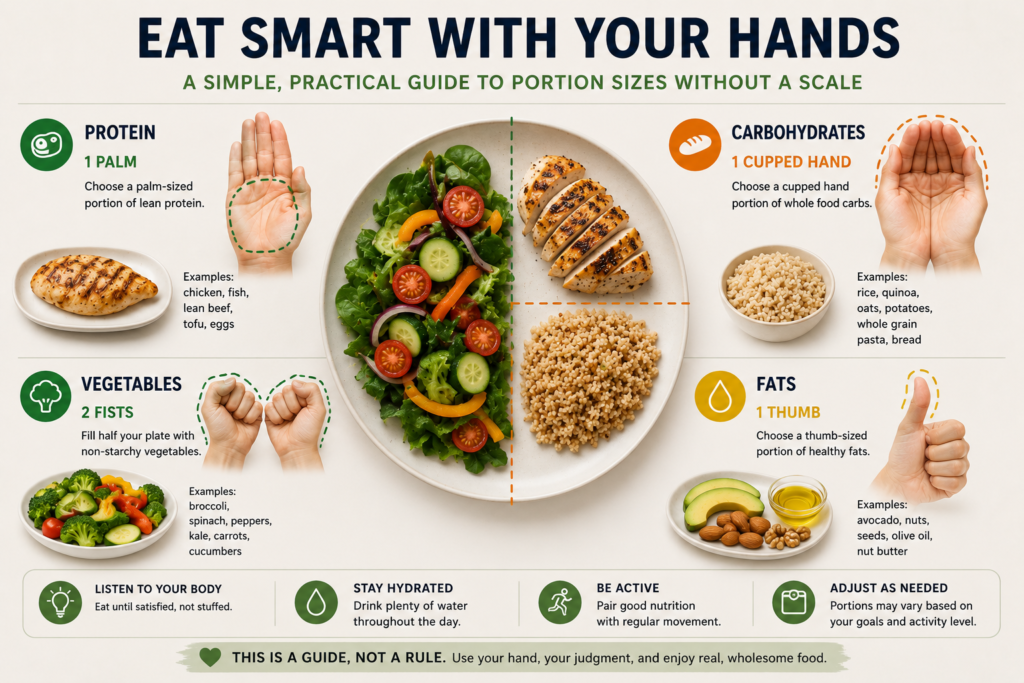
Here is a simple formula:
1 palm protein + 1 cupped hand carbs + 2 fists vegetables + 1 thumb fat
This can become many different meals.
Example 1: Chicken Rice Bowl
- 1 palm grilled chicken breast
- 1 cupped hand cooked rice
- 2 fists roasted zucchini and peppers
- 1 thumb olive oil or yogurt dressing
Approximate calories: 380–430 kcal
Example 2: Tuna Potato Salad Bowl
- 1 palm tuna
- 1 small potato
- 2 fists cucumber, tomato, lettuce, and green beans
- 1 thumb light mayo or olive oil dressing
Approximate calories: 350–420 kcal
Example 3: Egg and Toast Plate
- 2 eggs or 1 egg + extra egg whites
- 1 slice whole-grain toast
- 2 fists tomatoes, spinach, cucumber, or peppers
- small avocado slice or teaspoon olive oil
Approximate calories: 350–430 kcal
Example 4: Tofu Noodle Stir-Fry
- 1 palm tofu
- 1 cupped hand cooked noodles
- 2 fists stir-fry vegetables
- 1 thumb sesame oil, peanuts, or sauce
Approximate calories: 380–450 kcal
How to Estimate 400 Calories in a Bowl
Bowls can be trickier than plates because everything is mixed together. It is easy to add “just a little more” rice, sauce, cheese, or nuts.
Use this bowl structure:
Base: 2 fists vegetables
Protein: 1 palm
Carb: 1 cupped hand
Fat or sauce: 1 thumb
A 400-calorie bowl should look colorful and full, but not heavy with calorie-dense toppings.
Best low-calorie volume boosters:
- lettuce
- cucumber
- cabbage
- zucchini
- peppers
- tomatoes
- spinach
- mushrooms
- green beans
- cauliflower rice
- shredded carrots
Higher-calorie ingredients to measure visually:
- rice
- pasta
- cheese
- oil
- nuts
- seeds
- avocado
- creamy sauces
- pesto
- peanut dressing
The fastest way to keep bowls around 400 calories is this:
Go big on vegetables, moderate on protein and carbs, small on fats and sauces.
How to Estimate 400 Calories When Eating Out
Restaurant meals are usually much larger than home-cooked portions. Even healthy-looking meals can contain more oil, sauce, cheese, or starch than expected.
Use these tricks:
Ask for sauce on the side
Sauces can add 100–300 calories without making the meal much more filling. Dip your fork into the sauce instead of pouring it all over the plate.
Choose grilled, roasted, steamed, or baked
Fried or creamy dishes usually contain much more added fat.
Split the carbohydrate portion
If your plate comes with a large serving of rice, fries, pasta, or bread, eat about one cupped hand and leave the rest.
Add vegetables first
A side salad, grilled vegetables, or soup can make the meal feel more complete.
Box half before you start
If the portion is clearly oversized, put part of it aside first. It is much easier to stop before eating than after you are already full.
The Biggest Mistakes That Push a Meal Over 400 Calories
A meal can start as a healthy 400-calorie plate and still become much higher in calories because of small extras.
Watch out for:
Too much oil
Oil is healthy, but one tablespoon has around 120 calories. If you cook with oil and also add dressing, calories rise quickly.
Better option: use a teaspoon of oil, cooking spray, lemon juice, vinegar, mustard, salsa, or yogurt-based dressing.
Too many toppings
Nuts, seeds, cheese, croutons, avocado, olives, and creamy sauces can all be nutritious, but they add up fast.
Better option: choose one topping, not five.
Oversized carb portions
Rice, pasta, potatoes, wraps, bread, and grains are easy to over-serve.
Better option: use one cupped hand as your starting point.
Protein that is too fatty
Salmon, eggs, cheese, sausages, ground meat, and chicken thighs can all fit into a 400-calorie meal, but they leave less room for added fats.
Better option: if your protein is higher in fat, skip extra oil, cheese, or avocado.
“Healthy” snacks eaten from the bag
Nuts, granola, crackers, protein bites, and dried fruit are easy to overeat when eaten straight from the package.
Better option: portion them into a small bowl first.
Quick 400-Calorie Portion Cheat Sheet
Use this when you do not want to count or weigh.
For most lunch and dinner meals:
Protein: 1 palm
Vegetables: 2 fists
Carbs: 1 cupped hand
Fat: 1 thumb
For lower-carb meals:
Protein: 1–1½ palms
Vegetables: 2–3 fists
Carbs: ½ cupped hand or skip
Fat: 1 thumb
For higher-protein meals:
Protein: 1½ palms
Vegetables: 2 fists
Carbs: ½–1 cupped hand
Fat: ½–1 thumb
For breakfast:
Protein: Greek yogurt, cottage cheese, eggs, turkey, tofu, or protein powder
Carbs: oats, whole-grain toast, fruit, or potatoes
Volume: berries, vegetables, or salad
Fat: nut butter, seeds, avocado, or cheese — small amount only
How Accurate Is This Method?
This method is not perfectly accurate. And that is okay.
Food scales and calorie-tracking apps can give more precision, especially in the beginning. But visual portion methods are often easier to maintain long-term.
The goal is not to hit exactly 400 calories every time.
A meal around 350–450 calories can still fit the 400-calorie approach. What matters most is consistency over time.
Some meals will be slightly higher. Some will be slightly lower. That is normal.
This approach gives you freedom from constant weighing while still keeping structure.
When You Might Still Want to Use a Scale
A food scale can be useful occasionally, especially for foods that are easy to underestimate.
You may want to weigh these once or twice just to train your eye:
- pasta
- rice
- oats
- cheese
- nuts
- peanut butter
- olive oil
- granola
- avocado
- creamy sauces
After you see what a real portion looks like, you can go back to estimating.
Think of the scale as a learning tool, not a lifelong obligation.
Final Thoughts
Estimating 400-calorie portions without a food scale is absolutely possible.
The easiest method is to build your meal like this:
½ plate vegetables + ¼ plate protein + ¼ plate complex carbs + 1 small portion of healthy fat
Or use your hand:
1 palm protein + 1 cupped hand carbs + 2 fists vegetables + 1 thumb fat
This keeps meals simple, balanced, filling, and realistic — especially for busy days when you do not have time to weigh every ingredient.
A 400-calorie meal should not feel like punishment. It should feel like a smart, satisfying plate you can repeat again and again.
Because the best meal plan is not the one you can follow perfectly for three days.
It is the one you can actually live with.