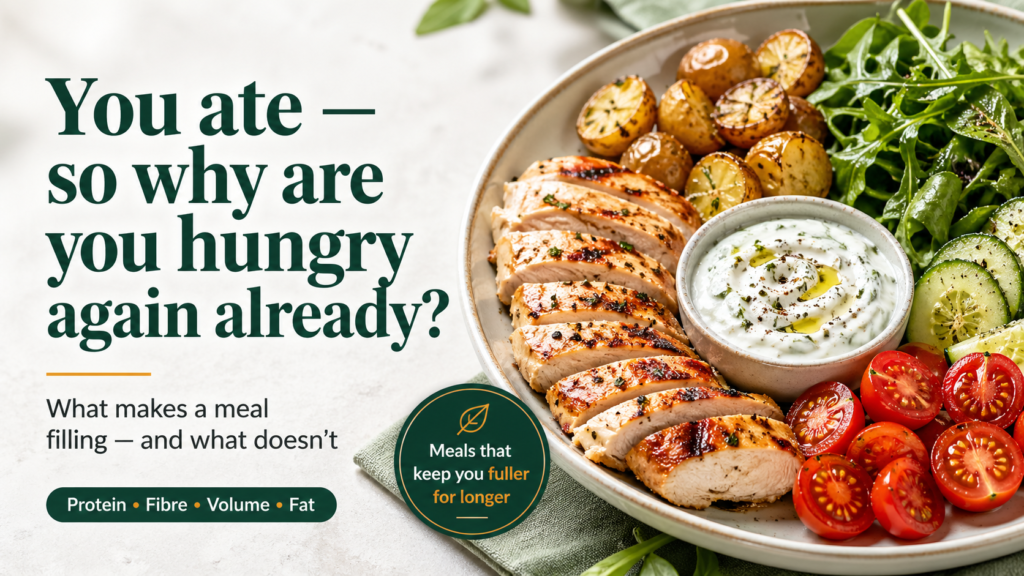
You ate — so why are you hungry again already?
If you get hungry quickly after eating, it is usually not a willpower problem. More often, it comes down to how your meal was built. A meal that is low in protein, fibre, healthy fats, or overall volume may leave you thinking about snacks much sooner than expected. Foods low in protein and healthy fats, and meals built mostly around refined carbs, are also more likely to leave people feeling hungry again faster.
The good news is that this is often fixable. With a few practical changes, a meal around 400 kcal can feel far more satisfying and steady than a random 400-calorie lunch, snack plate, or quick breakfast.
Quick answer
You may get hungry quickly after eating if your meal was too low in protein, fibre, or healthy fats, too small overall, high in refined carbs, or eaten too fast. Poor sleep, stress, and dehydration can also make hunger feel stronger. In many cases, the structure of the meal matters more than the calorie number alone.
In this article
- Why you get hungry quickly after eating
- 9 common reasons you feel hungry again too fast
- Why one 400 kcal meal fills you up and another does not
- How to build a more filling meal
- What a filling 400 kcal meal can look like
- When hunger may need medical advice
- FAQ
Why you get hungry quickly after eating
Feeling hungry again soon after a meal can happen for simple reasons. Sometimes the meal was too light in the wrong way. Sometimes it was missing enough protein, fibre, or fat to keep you satisfied. Other times, things like poor sleep, stress, eating too quickly, or not drinking enough can make a normal meal feel less satisfying than it should.
It is also worth remembering that two meals with the same calories can feel completely different in real life. A 400 kcal meal with protein, vegetables, fibre-rich carbs, and some fat will usually keep you going longer than a 400 kcal meal made mostly of refined carbs or snack-style foods. Foods low in protein and high in refined sugars are especially likely to leave people hungry again sooner.
9 common reasons you feel hungry again too fast
1. Your meal was too low in protein
Protein helps a meal feel more substantial. If your meal was mostly toast, crackers, cereal, pastries, or a small pasta portion with very little protein, it may not hold you for long. Cleveland Clinic specifically notes that not getting enough protein is one common reason people feel hungry more often.
A practical fix is to make sure your meal includes a clear protein source such as chicken, tuna, eggs, Greek yogurt, cottage cheese, tofu, beans, or lentils.
2. You did not eat enough fibre
Fibre adds bulk and slows things down in a helpful way. Meals that include vegetables, fruit, beans, oats, potatoes, or whole grains often feel steadier than meals that are lower in fibre. Cleveland Clinic also identifies lack of fibre as one reason hunger can keep coming back.
This is one reason a yogurt bowl with berries and oats often feels more filling than a sweet pastry, even if the calories are similar.
3. Your meal was high in refined carbs
A meal built mostly around refined carbs can feel satisfying for a short while but not keep you full for long. Cleveland Clinic’s 2026 guidance notes that foods low in protein and high in refined sugars tend to leave people feeling hungry again, with examples such as sugary cereals, donuts, granola bars, white pasta, and sweetened smoothies.
That does not mean all carbs are the problem. It usually means the meal needs more balance.
4. The meal was too small overall
Sometimes the issue is not the ingredient list but the size of the meal. A lunch that is technically 250 to 300 kcal may simply not be enough for that part of your day, especially if you have been active, slept poorly, or had a lighter breakfast.
This is also where many people go wrong with “healthy eating.” They eat something tidy and low-calorie, but not something satisfying.
5. You ate too fast
If you race through a meal, your brain may not fully catch up with what your stomach is doing. Cleveland Clinic recommends slowing down because eating mindfully, chewing slowly, and sipping water can help your brain catch up with your stomach. Associated Press reporting quoting Cleveland Clinic experts also notes that fullness signals can take around 20 minutes to register.
This is not about turning every lunch into a mindfulness exercise. It is just a reminder that inhaling your food at your desk often does not help.
6. You may actually be thirsty
Sometimes what feels like hunger is really thirst. Cleveland Clinic notes that dehydration can cause hunger pangs because your body may mistake thirst for hunger.
If you notice that “I need a snack” feeling hits hard in the afternoon, try water first and then check in again 10 to 15 minutes later.
7. Poor sleep can make hunger feel stronger
Poor sleep can affect appetite and make food cravings feel louder the next day. Cleveland Clinic lists not getting enough sleep as one reason people may feel hungry more often, and recent research also links sleep disruption to dysregulation of hunger and satiety.
This is one reason a perfectly normal meal can feel less satisfying after a bad night.
8. Stress can make you feel snacky even after a meal
Stress does not always feel like obvious hunger. Sometimes it shows up as grazing, restlessness, or the feeling that something is missing after you eat. Cleveland Clinic also notes stress as one factor that can affect appetite and leave you feeling hungry more often.
That does not mean the hunger is fake. It just means the solution may not always be “eat more calories.”
9. Sometimes it may be worth checking with a doctor
Occasional hunger after a light or unbalanced meal is normal. But if you feel intensely hungry all the time, or the change is new and unusual for you, it is worth speaking to a healthcare professional. Cleveland Clinic notes that polyphagia, or extreme hunger, can be associated with diabetes and other medical causes.
If frequent hunger comes with unusual thirst, frequent urination, unexplained weight loss, or other symptoms, do not ignore it. NHS guidance on excessive thirst also recommends medical review when thirst persists or comes with frequent urination.
Why one 400 kcal meal fills you up and another does not
This is where a lot of confusion comes from.
A 400 kcal meal can feel very light and unsatisfying, or balanced and genuinely filling. The difference is usually not just the calorie number. It is the structure.
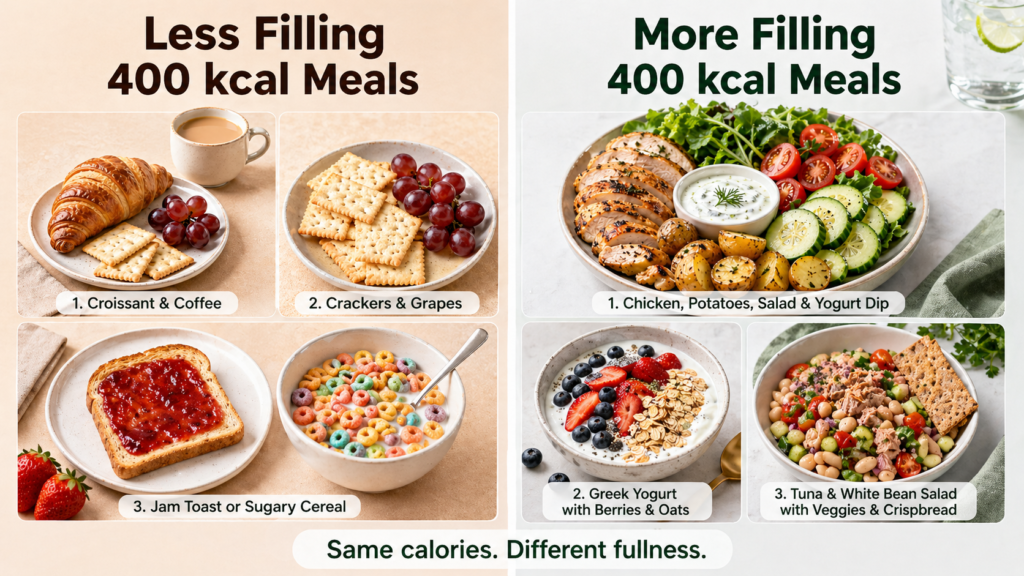
Less filling 400 kcal meal
- pastry and coffee
- crackers, cheese, and a few grapes
- plain toast with jam
- small white pasta portion with very little protein
More filling 400 kcal meal
- chicken, baby potatoes, crunchy vegetables, and yogurt dip
- Greek yogurt with berries, oats, and chia
- tuna, beans, chopped vegetables, and crispbread
- egg muffins with potatoes and tomatoes
The second group usually works better because it has more of the things that support fullness: protein, fibre, volume, and enough fat to make the meal feel complete.
How to build a more filling meal without making it complicated
If you want a meal to keep you full for longer, focus less on the calorie number alone and more on the structure.
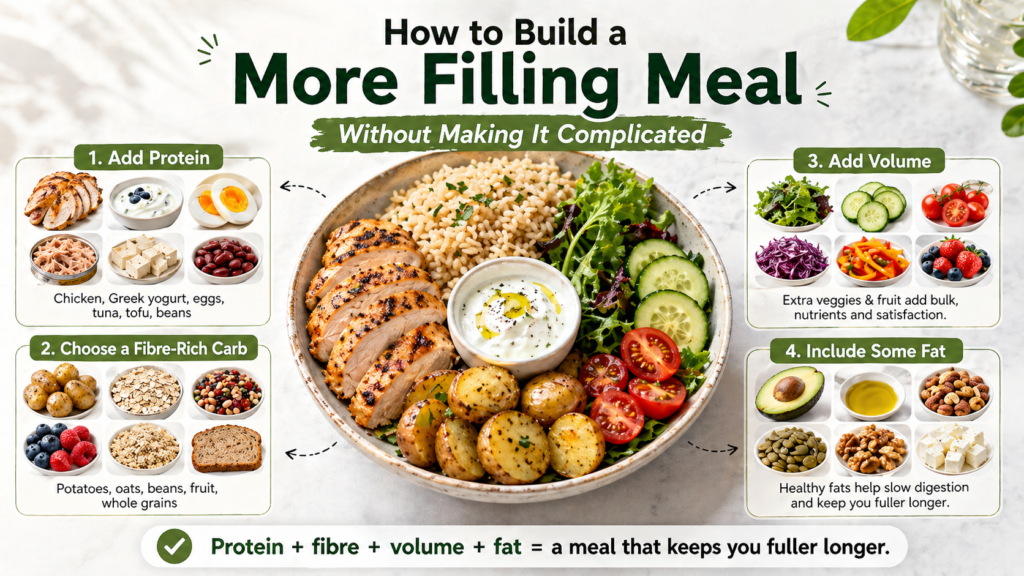
Use this simple meal formula
1. Add a clear protein source
Chicken, eggs, tuna, Greek yogurt, cottage cheese, tofu, beans, or lentils.
2. Include a fibre-rich carb
Potatoes, oats, beans, fruit, whole grains, or pasta balanced with vegetables and protein.
3. Add volume
Vegetables or fruit make a meal feel bigger without making it heavy.
4. Include some fat
Olive oil, avocado, seeds, nuts, cheese, or a yogurt-based dressing can make a meal feel more complete.
This approach is far more helpful than trying to stay full on a meal that is technically low in calories but missing the pieces that help with satisfaction. Protein, fibre, and healthy fats are repeatedly highlighted in clinician guidance as the parts of a meal that help keep hunger steadier.
What a filling 400 kcal meal can look like
Example 1: Lunchbox-style meal
Chicken breast, baby potatoes, cucumber, cherry tomatoes, and a yogurt-herb dip.
Example 2: Simple breakfast
Greek yogurt, berries, oats, and chia seeds.
Example 3: No-cook lunch
Tuna, white beans, crunchy chopped vegetables, and rye crispbread.
None of these meals need to be complicated. They just need enough structure to do their job.
A quick hunger check
Before assuming you need “more discipline,” ask yourself:
- Did this meal include enough protein?
- Was there any real fibre in it?
- Was it mostly refined carbs?
- Did I eat it in five minutes?
- Have I had enough water today?
- Did I sleep badly last night?
- Am I hungry, or just stressed and mentally done?
This kind of quick check is often more useful than obsessing over calories.
When hunger after eating may need medical advice
If this happens once in a while after a light breakfast or a rushed lunch, that is not unusual. But if you feel hungry all the time, or if your appetite has changed suddenly, it is worth paying attention.
Speak to a healthcare professional if frequent hunger comes with intense thirst, frequent urination, unexplained weight loss, or other symptoms that do not feel normal for you. Persistent excessive hunger can sometimes be linked to an underlying condition rather than meal structure alone.
Final takeaway
If you get hungry quickly after eating, it does not automatically mean you are overeating, undereating, or doing something wrong. In many cases, the meal simply was not built to keep you full.
A balanced 400 kcal meal can absolutely feel satisfying. The key is making sure it includes enough protein, fibre, volume, and structure to actually work in real life.
FAQ section
FAQ
Why do I feel hungry an hour after eating?
You may have eaten a meal that was low in protein, fibre, healthy fats, or overall volume. Eating quickly, poor sleep, stress, and dehydration can also make hunger come back faster.
Can a 400 calorie meal still be filling?
Yes. A 400 calorie meal can feel very satisfying when it includes protein, fibre, good volume, and a balanced structure. Calories matter, but meal composition matters too.
Why do sugary or refined meals make me hungry again so fast?
Meals built mostly around refined carbs often feel satisfying in the moment but may not keep you full for long, especially if they are low in protein and fibre. Cleveland Clinic specifically highlights refined sugars and low-protein meals as a common setup for rebound hunger.
How can I make my meals more filling without eating a lot more?
Start by adding a stronger protein source, more vegetables or fruit, and a fibre-rich carb. In many cases, changing the structure of the meal helps more than simply adding calories.
Can poor sleep make me feel hungrier?
Yes. Poor sleep can affect appetite and make food cravings feel stronger the next day.
When should I talk to a doctor about constant hunger?
It is worth checking in if your hunger feels unusually intense, happens all the time, or comes with symptoms like unusual thirst, frequent urination, or unexplained weight loss.